Lighter Points Program: How Points Are Earned, Weekly Pool & Airdrop Outlook
Table of Contents
- What is the Lighter points program?
- How do you earn Lighter points?
- The numbers Lighter does publish
- How does point weighting work across market tiers?
- Optimization strategies by trader type
- Scalpers and high-frequency traders
- Swing traders
- Liquidity providers
- Where the referral program fits, and where it does not
- Common mistakes that cost points
- How do you check your Lighter points balance?
- When is the LIT airdrop, and is any of it promised?
The Lighter points program is the scoreboard for the public beta, and most traders read it as the runway to a future LIT token airdrop. LIT already trades as a perpetual on Lighter, so the live LIT market is where the market's current read on it sits, whatever an airdrop eventually looks like. This guide is the complete picture: what the program is, and how to actually maximize your position in it. It covers how points are weighted, how to optimize by trading style, the mistakes that drain your allocation without you noticing, and how to track your balance, all while keeping the airdrop framed as an estimate rather than a promise. None of this is financial advice.
Season 2 pays out 250,000 points a week (200,000 retail, 50,000 market making) every Friday, covering activity from Wednesday through Tuesday. Points reward genuine, quality-weighted trading. Community guides report maker liquidity and less-liquid markets earn more than grinding taker volume on ETH/BTC, though exact multipliers are not officially published. Sybil and self-trading earn zero. A referral code does not affect points — Lighter documents referrals as a separate, fee-based program. Any airdrop timing or per-point value is an estimate. There is no confirmed TGE.
What is the Lighter points program?
 Lighter
The Lighter points program is the mechanism the exchange uses to measure and reward real usage during its public beta. Every week, points are distributed to users based on their trading activity, and the running total sits in your account as a record of participation. Season 1 closed with the final Private Beta distribution on September 30, 2025; Season 2 is the current live season, distributing points weekly on Fridays and open to public users. Points are the widely-read path to an eventual LIT airdrop, though the conversion and timing are unconfirmed. The core rule is simple: the program rewards organic trading through both the web app and the API, and it explicitly excludes Sybil activity, self-trading, and similar artificial engagement. Confirm every mechanic on the official docs, because Lighter can adjust Season 2 at its discretion.
How do you earn Lighter points?
Points accrue from real trading on app.lighter.xyz, through the interface and the API alike. The program is quality-weighted rather than a raw volume race, and a few factors drive how much each dollar of activity is worth.
The numbers Lighter does publish
Most write-ups on this program lean on community estimates, because the headline formula is deliberately unpublished. The docs do put hard numbers on the size and shape of the pool, and those are worth knowing before you read anyone's multiplier claims.
| What is published | Season 2 figure | Where it comes from |
|---|---|---|
| Total weekly pool | 250,000 points, scaled to stay at that total | Market Makers |
| Retail share | 200,000 points a week | Retail |
| Market-making share | 50,000 points a week, 20% of the total, premium accounts only | Market Makers |
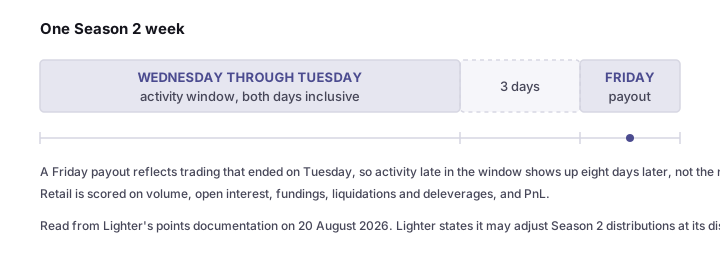
| Payout day | Every Friday | Points Program |
| Activity window | Wednesday through Tuesday, both inclusive, paid the Friday after | Retail |
| Retail categories | Volume, open interest, fundings, liquidations and deleverages, PnL | Retail |
| Maker volume score | score = volume + max(0, (volume minus $2.5B) x 0.25), a 25% bonus on weekly maker volume above $2.5B, with every market weighted equally for this score | Market Makers |
| Accounts per person | Up to 10 without penalty | Retail |
| Premium weighting | A premium account changes the weight of the metrics, and PnL earned on one may be worth more points | Retail |
| Points to LIT conversion | Not published anywhere | n/a |
Read from Lighter's own points documentation on 20 August 2026. Season 1 closed with the final Private Beta distribution on 30 September 2025, and Lighter states it may adjust Season 2 distributions at its discretion.
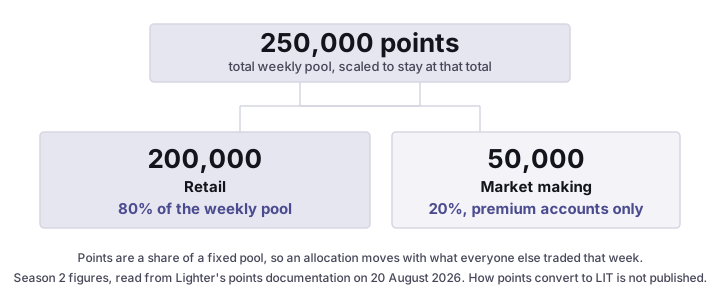
Two of those rows do more work than the rest. The 250,000 weekly total turns points from an open-ended score into a share of a fixed pool, so your allocation moves with what everyone else did that week and not only with what you did. The Wednesday-to-Tuesday window means a Friday payout reflects trading that ended three days earlier, which is why a burst of activity on Wednesday night shows up eight days later rather than tomorrow.
The market-maker score is the one place Lighter publishes an actual formula, and the kink in it is the interesting part. Below $2.5B of weekly maker volume your score is just your volume; above it, every extra dollar counts for $1.25. That threshold is aimed at desks rather than at retail size, and it is the clearest evidence that the two tracks are scored on different curves rather than being one pool with a maker bonus bolted on.
| Action | How it is weighted | Rate or multiplier | Status |
|---|---|---|---|
| Volume and consistency | Steady activity across markets accrues over time | Not published | Documented direction |
| Maker (resting limit) orders | Points proportional to the share of liquidity you provide | Not published | Documented direction |
| Taker fills | Removes depth, so weighted below maker flow | Not published | Documented direction |
| Deep majors (ETH, BTC) | Lowest per-dollar reward — the book already has depth | Not published | Documented direction |
| Newer or low-liquidity markets | Weighted by how much liquidity the market still needs | "several times more"; the widely-quoted 5x is a community estimate | Community estimate |
| Holding position quality | Real directional risk reads better than mechanical churn | Not published | Community estimate |
| Referrals | Not a points mechanic. Lighter's referral program pays fee kickbacks and a Premium fee rebate, and its points documentation does not mention referrals | n/a | Lighter referral docs, read 2026-08-14 |
| Referral share to the referrer | Share of the fees referred users pay, not their points | 10% Bronze, 20% Silver, 30% Gold | Lighter referral docs, read 2026-08-20 |
| Wash trading, self-trading, Sybil clusters | Excluded, and can flag the account | Zero | Documented |
Rates as documented on docs.lighter.xyz and read in July 2026. Lighter publishes the shape of the incentive but not a points formula, so every "not published" cell is genuinely unpublished rather than omitted here — treat rows marked community estimate as inference from observed distributions, and re-check before building a strategy on any single figure. Season 2 pays out weekly on Fridays and Lighter can adjust it at its discretion.
- Volume and consistency. Steady trading across markets accumulates points over time. Consistency reads as genuine usage, which is what the program is built to reward.
- Maker versus taker. Resting limit orders that add depth to the book are treated differently from taker orders that only remove it. Lighter's market-maker points weight the liquidity you provide, so maker flow that seeds the order book is rewarded in a way pure taker fills are not.
- Market selection. Lighter weights markets by how much liquidity they still need. Markets that lack depth on Lighter, or that trade heavily elsewhere, carry more weight than already-deep majors. Community farming guides consistently report that newer or less-liquid markets earn several times more than ETH or BTC, though Lighter has not published an exact multiplier.
- Holding and position quality. Community guides report that holding positions rather than flipping them in and out, and taking real directional risk, reads better than mechanical churn. Funding payments and realized trading performance are cited as inputs that can shape your share, though Lighter has not published the exact weighting. The safe read: behave like a trader with a view, not a bot cycling the same size.
- Referrals are separate. Lighter documents referrals and points as two different programs. The referral program pays the referrer a share of the fees their referred users pay and offers the referred user a one-week Premium fee rebate. Lighter's points documentation does not describe any referral bonus, so do not expect a code to move your points.
One nuance worth stating plainly: Lighter has not published a public points formula. What is documented is the shape of the incentive (organic trading rewarded, market-maker liquidity weighted, Sybil and self-trading excluded) and the weekly Friday cadence. The specific multipliers that circulate in third-party farming guides are inference from observed distributions, not numbers Lighter has confirmed. That gap is exactly why the durable strategy is to optimize for the documented direction rather than chase a rumored figure that can change the next Friday.
Lighter is unusually direct about why. The retail page says the detection metrics "will not be disclosed here so as not to encourage their exploitation", and it spells out three properties that break the arithmetic anyone tries to do on a leaked multiplier:
- Points are not linear in the metric. The docs give the example plainly: twice the volume "will not always yield 2x the points; it may result in 3x or 1.5x the points", and they note this holds beyond volume.
- Markets are not weighted equally. $100 of volume on BTC does not earn what $100 on HYPE earns, and the same asymmetry runs through the other categories.
- The clock differs by category. Some are measured per market and some globally, some daily and some weekly, so two accounts with identical weekly totals can land in different places.
One more line is worth quoting, because it kills a popular farming idea outright: "intentionally losing money or getting liquidated will not be beneficial". Liquidations and deleverages are a scored category, which some traders read as a reason to take one. They are scored as something the model wants to see less of.
Info
The market-maker weighting (points proportional to the share of liquidity you provide, with markets weighted by liquidity demand and risk) is documented on Lighter's docs. The specific "5x for low-liquidity pairs" figures that circulate in farming guides are community estimates, not an official formula. Treat the direction as reliable and the exact numbers as estimates. Verify on docs.lighter.xyz.
How does point weighting work across market tiers?
Rather than a public tier table with fixed thresholds, Lighter uses a dynamic weighting model. Each market is assigned a weight that reflects both its liquidity demand and its risk, and you earn points proportional to your share of the liquidity or activity in that market. The practical read-through:
- Deep majors (ETH, BTC): lowest per-dollar reward. Plenty of existing liquidity means Lighter needs less incentive to attract more.
- Mid and newer markets: higher weighting, because the book still needs depth. This is where community guides report the bulk of the outperformance.
- Maker liquidity in thin books: the strongest documented lever, since you are directly providing what the weighting model is trying to buy.
There is also a widely-cited soft threshold around 100 points that unlocks referral invites, after which the referral layer compounds your base activity. Because these are directional rather than a published rate card, the safe posture is to understand the shape of the incentive and confirm specifics on the docs before building a strategy around any single number.
Start earning points with code LIGHTERPEDIA
Signing up with code LIGHTERPEDIA applies the code automatically. Lighter’s referral documentation says new sign-ups are offered one week of Premium with trading fees rebated on the first $10M of volume, and that rebates are discretionary. Standard accounts trade at 0% maker and taker either way.
Start Trading on LighterOptimization strategies by trader type
The right approach depends on how you already trade. Force a style that isn't yours and you'll churn, lose money to slippage, and produce the kind of thin, mechanical flow the program is designed to discount. Match the program to your actual habits instead.
Scalpers and high-frequency traders
If you trade often, your edge is order type and market choice, not sheer volume. Lean on maker orders: rest limit orders that add depth rather than crossing the spread on every fill. On a zero-fee exchange the usual maker-rebate math changes, but the points weighting still favors liquidity provision, so posting depth is where the frequency pays off. Spread that maker activity into markets that need it rather than fighting for a sliver of an already-deep ETH book.
Swing traders
Lower frequency, larger and longer-held positions. Your points come from genuine, sized exposure held like a real position rather than opened and closed in seconds. Two-sided, unhurried trading across a handful of markets reads as exactly the organic usage the program rewards, and it avoids the wash-trading patterns that get flagged. You don't need to trade constantly; you need your activity to look like what it is.
Liquidity providers
The most direct route to the market-maker weighting is to actually make markets. Providing resting liquidity in books that lack depth earns points proportional to your share of that liquidity, and the thinner the market, the higher the weight. Lighter also runs a separate Liquidity Partner Program and an LLP vault for deeper liquidity provision; those are distinct tracks from base trading points, so read the docs on how each is scored before committing size.
Tip
There is no single "best" strategy, only the best version of how you already trade. A scalper posting maker depth in mid-liquidity markets, a swing trader holding real positions, and an LP seeding thin books are all doing the thing the program rewards: adding genuine value to the exchange. Pick the one that fits, then do it well.
Where the referral program fits, and where it does not
This is the part most farming guides get wrong, so it is worth being blunt. Lighter's referral program is not a points mechanic. Its points documentation does not mention referrals anywhere, and the referral documentation describes a fee-sharing arrangement with no points component at all. A code cannot move your points balance, and nobody's code can.
What the program actually does, read from the docs on 20 August 2026:
- The referrer earns a cut of the gross trading fees their referred users pay: 10% at Bronze, 20% at Silver (15 referrals active 5+ days), 30% at Gold (50 referrals active 5+ days). Upgrades are reviewed on Mondays and are not applied retroactively.
- The referred user is offered one week of Premium with fees rebated on the first $10M of volume. Lighter describes rebates as discretionary.
- Standard accounts are 0% either way, so a code cannot make ordinary trading cheaper (see Lighter fees explained for why there is nothing there to discount).
- Attribution is permanent and applies only to sign-ups on or after 28 July 2026, so it is a decision you make once, at sign-up, and cannot revisit.
The practical read: use a code if you are signing up anyway, since the free Premium week has value if you trade enough to reach the premium tiers, but do not treat it as a points lever. Our referral code guide walks through the tiers, and the referral page carries the current terms.
Start Trading on LighterCommon mistakes that cost points
Most lost allocation comes from a short list of avoidable errors.
- Wash trading and self-trading. The single most expensive mistake. It earns zero, and repeated instant open-and-close activity can flag your account as a Sybil and block future orders. On a fully verifiable exchange where matching is provable, the pattern is detectable.
- Grinding only deep majors. Pouring volume into ETH and BTC is the lowest per-dollar reward there is. The weighting model steers points toward markets that still need depth, so majors-only farming leaves points on the table.
- Taker-only trading. Skipping maker orders means skipping the liquidity-provision weighting entirely. If you never rest an order on the book, you never earn the part of the program that pays for depth.
- Ignoring the referral boost. Signing up without a code forfeits the free sign-up points layer. It costs nothing to include one.
- Running Sybil clusters. Funding many farm accounts burns real Ethereum gas on every deposit and withdrawal, for activity that earns nothing. The economics are backwards even before detection risk.
Warning
Do not build a Sybil operation to farm points. It is explicitly excluded from earning, it is detectable on a verifiable exchange, and it wastes real gas on deposits and withdrawals. Genuine trading is both the compliant path and the economically rational one.
How do you check your Lighter points balance?
Your points balance and weekly distributions show up in your Lighter account on the points or rewards view in the app. Because Season 2 distributes on Fridays, the reliable rhythm is to check after each weekly distribution, note how your activity translated into points, and adjust market and order-type choices for the following week. A few habits help:
- Watch the weekly delta, not just the running total. It tells you which of your trades actually earned, so you can lean into what worked.
- Follow official channels. Season 2 rules and amounts are adjustable at Lighter's discretion, so a rule that held last week can shift. The docs and official announcements are the source of truth.
- Ignore third-party point-value calculators. Any tool quoting a dollar value per point is guessing. LIT trades as a perpetual on Lighter, but there is no spot market and no published conversion, so a per-point figure has nothing to anchor to.
- Keep your own log. A short weekly note of what you traded, in which markets, and how many points landed builds a personal dataset far more useful than any external estimate. After a few weeks you can see which markets and order types paid off for your size, which is the only calibration that actually matters.
Treat the weekly checkpoint as a feedback loop rather than a scoreboard you glance at. The traders who do well are usually the ones who noticed, three or four Fridays in, that their maker orders in a mid-liquidity market earned more per dollar than their taker volume on ETH, and then shifted weight accordingly. That is a boring, unglamorous edge, and it is the one the program is built to reward.
When is the LIT airdrop, and is any of it promised?
Points are the obvious candidate to feed a LIT airdrop, and the community treats Season 2 as airdrop-farming season. Everything about the airdrop itself, though, is currently an estimate:
- No confirmed TGE. There is no announced Token Generation Event or listing date for LIT.
- No confirmed conversion. How points map to tokens (ratio, caps, eligibility, cliffs) is not published.
- No confirmed value. Any per-point dollar figure is a guess. The LIT perpetual shows you the market's read on the token, but a perp price is not a distribution, and no ratio has been published to convert one into the other.
- No published vesting. Cliffs, lockups and unlock schedules for any points-derived allocation are undocumented too, so even a headline allocation number would not tell you when you could act on it.
What is confirmed is the supply backdrop the token is being built on. Lighter's 15.5M LIT burn showed a revenue-funded, on-chain supply reduction, which tells you how the protocol intends to treat the token over time. That is useful context for whether to be an active user, but it is not a prediction and it does not change how you earn points: trade real volume, provide liquidity, avoid anything artificial, and confirm mechanics on official channels.
The upside of the uncertainty is that it favors real traders. A quality-weighted program that excludes Sybils rewards the users actually using the exchange, which is what you'd be doing anyway if Lighter fits how you trade.
Cite this page
These figures are free to quote. Copy the citation or the link below.
Plain-text citation
Lighterpedia. "Lighter Points Program: How Points Are Earned, Weekly Pool & Airdrop Outlook." Published July 14, 2026, updated September 8, 2026. https://lighterpedia.com/ecosystem/lighter-points-programHTML link
<a href="https://lighterpedia.com/ecosystem/lighter-points-program">Lighter Points Program: How Points Are Earned, Weekly Pool & Airdrop Outlook — Lighterpedia</a>Methodology and reuse
The Season 2 figures on this page (the 250,000-point weekly pool, its retail and market-making split, the Friday payout, the activity window and the maker volume score) are read from Lighter's points program documentation. Nothing on this page states a per-point value or an airdrop conversion, because Lighter has not published one. They were read from the Lighter points program documentation on and re-verified against the live app. Exchanges change their schedules, so treat any figure older than that date as needing a fresh check — the date above is the one to compare against.
You may republish these figures with attribution and a link to https://lighterpedia.com/ecosystem/lighter-points-program.
Maximize your position with code LIGHTERPEDIA
Signing up with code LIGHTERPEDIA applies the code automatically. Lighter’s referral documentation says new sign-ups are offered one week of Premium with trading fees rebated on the first $10M of volume, and that rebates are discretionary. Standard accounts trade at 0% maker and taker either way.
Start Trading on LighterFrequently Asked Questions
Trade genuine, two-sided volume through the interface or API, favor maker (limit) orders over pure taker fills, and consider markets Lighter wants seeded rather than only ETH and BTC, since community guides report less-liquid markets earn more. Hold positions like a real trader rather than churning; a referral code does not affect points. Sybil and self-trading earn nothing. Confirm current mechanics on docs.lighter.xyz, because Lighter can adjust Season 2 at its discretion.
Lighter's market-maker points weight the liquidity you provide, so resting limit orders that add depth are rewarded in a way that pure taker fills are not. Community farming guides consistently report that providing liquidity and using limit orders outperforms grinding taker volume on major pairs. Exact multipliers are not published in an official formula, so treat any specific figure as an estimate and check the docs.
Community guides widely report that less-liquid or newer markets earn several times more points than deep pairs like ETH and BTC, because Lighter weights markets by how much liquidity they still need. This lines up with the documented market-maker approach of weighting markets by liquidity demand and risk. The exact multiplier is not officially published, so treat cited numbers as estimates and confirm on the official docs.
There is no confirmed Token Generation Event, no published points-to-token conversion, and no confirmed date. Points are widely expected to be the primary path to a future LIT distribution, but any timing or per-point value is an estimate. The reliable approach is to be a genuine active user and follow official announcements rather than acting on a rumored number. This is not financial advice.
The common ones are wash trading and self-trading, which earn zero and can flag your account; grinding only deep major pairs where per-dollar rewards are lowest; using only taker orders and skipping maker liquidity; ignoring the referral boost; and running Sybil clusters that burn gas for no reward on a verifiable exchange that can see the pattern.
Lighterpedia is an independent, unofficial resource. It is not affiliated with, produced by, reviewed by, endorsed by, or sponsored by Elliot Technologies, Inc., Lighter, Inc., or any of their affiliates. "Lighter" and the Lighter logo are trademarks of their respective owners, used here only to identify the platform this site writes about. For official information, go to lighter.xyz.
Nothing on this site is legal, tax, financial, or investment advice. Trading perpetual futures with leverage can lose you more than you deposit. Rules differ by jurisdiction and change often — check the primary sources and a qualified professional before acting on anything you read here.
This site contains referral links — see the disclosure in the author note above and our full disclaimer.
Ready to Start Trading?
Signing up with code LIGHTERPEDIA applies the code automatically. Lighter’s referral documentation says new sign-ups are offered one week of Premium with trading fees rebated on the first $10M of volume, and that rebates are discretionary. Standard accounts trade at 0% maker and taker either way.
Start Trading on Lighter